Soft Baits Bleed Color When the Plasticizer Moves
A pink mark on a white bait is not pigment powder that walked across. What crosses the gap is plasticizer, and the color it carries is the fraction of the colorant that dissolved in it. A mica flake is an insoluble solid tens of micrometres across, so it has no dissolved fraction to lose. That difference decides which colors stay in their own bait.
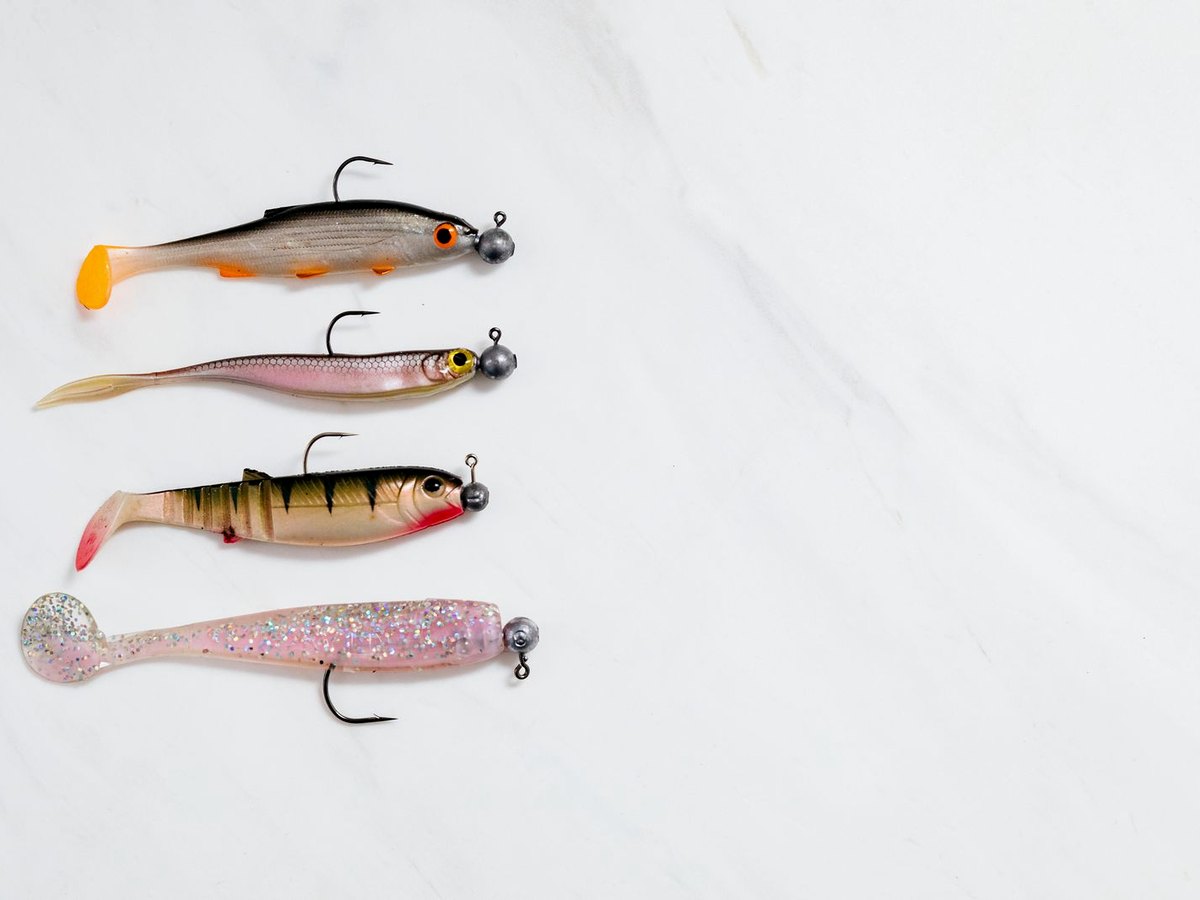
Fig. 1 — Colors packed into one box, bait bodies pressed flat against each other.
How color leaves one bait and lands on another
Two baits sit against each other in a box. The white one comes out with a pink patch, and the patch has the outline of the bait that was lying on top of it. The transfer copied a shape.
That shape is the useful clue. A stain that follows the contact line is consistent with transfer through something that occupied the gap between the two surfaces — a liquid. The shape alone does not establish the mechanism. Soft baits are colored through the whole body rather than coated, so dissolved color can leave from inside one bait and get into the other.
Three checks help distinguish dissolved-color transfer from solid-particle release:
- Dissolution. The colorant has to dissolve for its molecules to travel by the dissolved-color diffusion mechanism discussed here.
- Diffusion. What dissolved has to be mobile in the plasticizer that is carrying it.
- Size and embedding. Anything still solid must be assessed separately: a flake fully embedded in the matrix does not travel by that dissolved-color route.
The question buyers usually ask first — is it a dye or a pigment — does not answer these three checks.
What the plasticizer carries, and what it leaves behind
A soft bait is not molded from solid PVC. It starts as plastisol: PVC resin dispersed in plasticizer, turning clear at about 177 °C, with the colorant stirred in while the mix is hot and clear.
In a soft compound the plasticizer is typically 30–50 wt% of the formula. It is a small molecule and it is not chemically bonded to the PVC chain. Nothing chemically anchors it, so it can work its way to the surface and then onto whatever the bait is touching. [1] Molecular weight and volatility influence the pace; larger molecules generally escape the matrix less readily. [2]
The plasticizer is also a solvent. Colorant can dissolve more readily in it than in the resin. So what travels is not the colorant as supplied — it is the share of it that went into solution, riding a liquid that was already on its way out.
The same route can carry other small additives out of the surface layer. Bonding them to the base material, or making them bigger, can slow that traffic.
What stays behind are the undissolved solids. A contact face that has been losing plasticizer may also become harder or tackier than the rest of the bait.
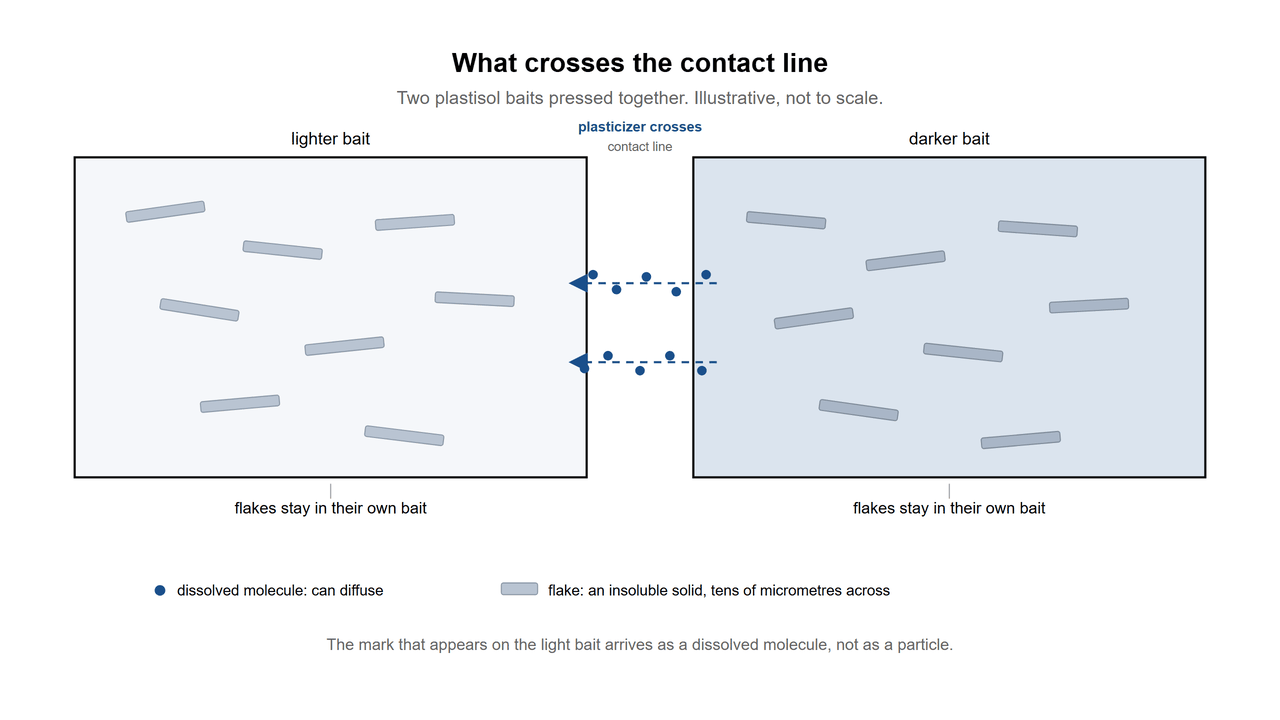
Fig. 2 — (illustrative) Cross-section at a contact line. Plasticizer and dissolved colorant cross the interface; flakes stay inside their own bait body.
How a colorant dissolves before it can travel
The first gate is dissolution, and it is where most practical judgments go wrong.
An organic pigment in plastic is not necessarily present entirely as solid particles. Some fraction can dissolve into the matrix and into the additives in it; the rest stays crystalline and locked in place. Only the dissolved fraction participates in this diffusion mechanism. The solid fraction stays fixed while it remains embedded.
In soft PVC the plasticizer can raise that dissolved fraction, because it can be a better solvent for the colorant than the resin is. A grade that passes in a rigid part can fail in a plasticized one for exactly this reason.
There is a counterintuitive consequence. In soft PVC, a low colorant loading can transfer more, not less. At low loading nearly all of it can go into solution; on cooling the system can become supersaturated and the excess comes out at the surface, where it is free to touch something. A heavy loading can leave more of it as undissolved solid, which stays put. This is a mechanism to investigate, rather than a loading recommendation.
This is the mechanism behind the case that puzzles buyers most: you changed suppliers and the bleed continued. If the replacement is the same class of organic colorant, it may dissolve in plasticizer for the same reason the first one did. A supplier change may improve consistency and quality control. It does not necessarily change solubility, unless the chemistry changes with it.
How big a particle has to be to stay put
The next check is size and embedding, and here migration research provides a useful distinction.
A review of migration studies on food-contact plastics concludes that particles fully embedded in a polymer matrix have no route out to the food. Modelling work puts nanomaterials in the same position: fixed in the matrix. Those studies also draw a line worth keeping — releasing a particle and migrating a dissolved ion are two different events. This is a general research conclusion, not a food-contact compliance conclusion for these baits. [3]
Note the scale that conclusion was written for: nanometres. A pearl flake runs 5–500 μm, and the grades in common use sit around 10–60 μm — much coarser than the nanoscale particles considered in that research. A fully embedded flake does not move through the matrix as a dissolved colorant does.
A second inorganic flake is worth knowing here: aluminium pigment belongs to the same class of insoluble solid rather than a dissolved colorant. The substrate adds another distinction. The flake is inorganic — mica, synthetic mica or borosilicate glass, coated with TiO₂. Inorganic colorants are almost insoluble in plasticizer, so the dissolved fraction available to carry is negligible. Very little soluble share, and a large solid held in the matrix. Platelet orientation develops during processing and is fixed as the matrix sets. [4]
Two boundaries worth stating. A flake that does not travel can still be scraped off a surface. And none of this says anything about how the base compound itself ages.
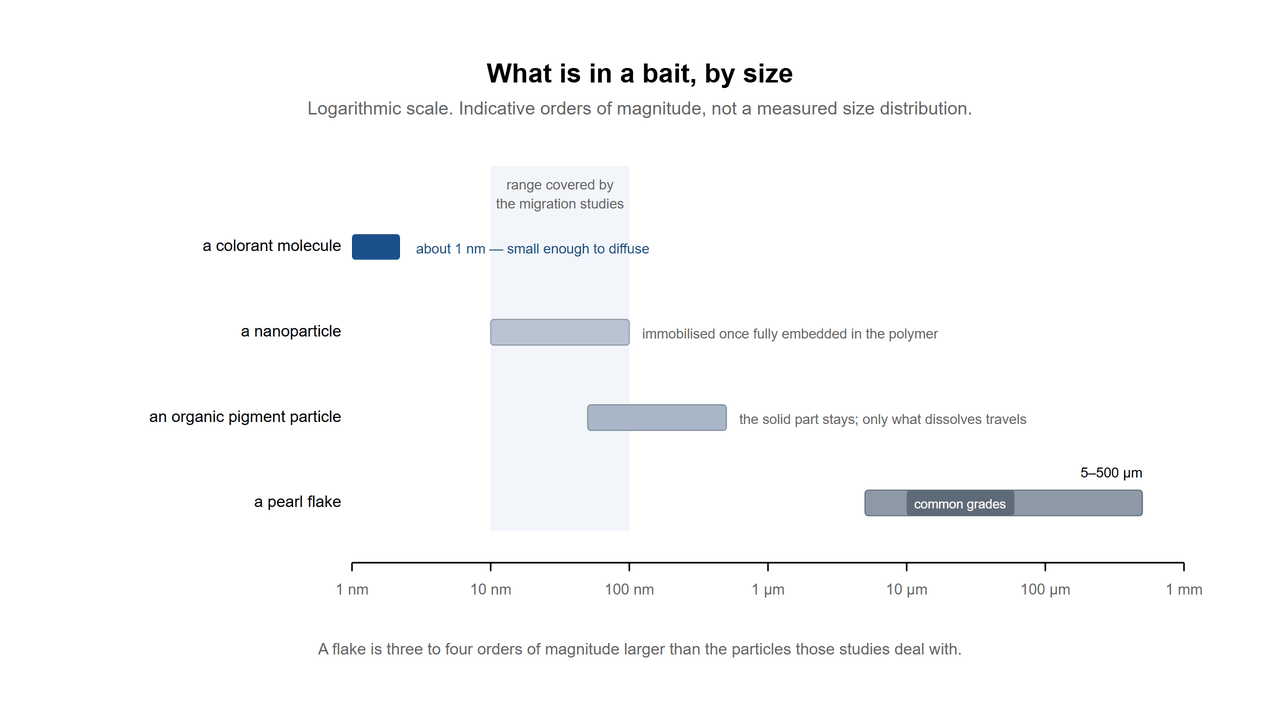
Fig. 3 — (illustrative) Order-of-magnitude comparison on a log scale: a single colorant molecule, a nanoparticle, an organic pigment particle, a pearl flake. Scale is indicative, not a measured distribution.
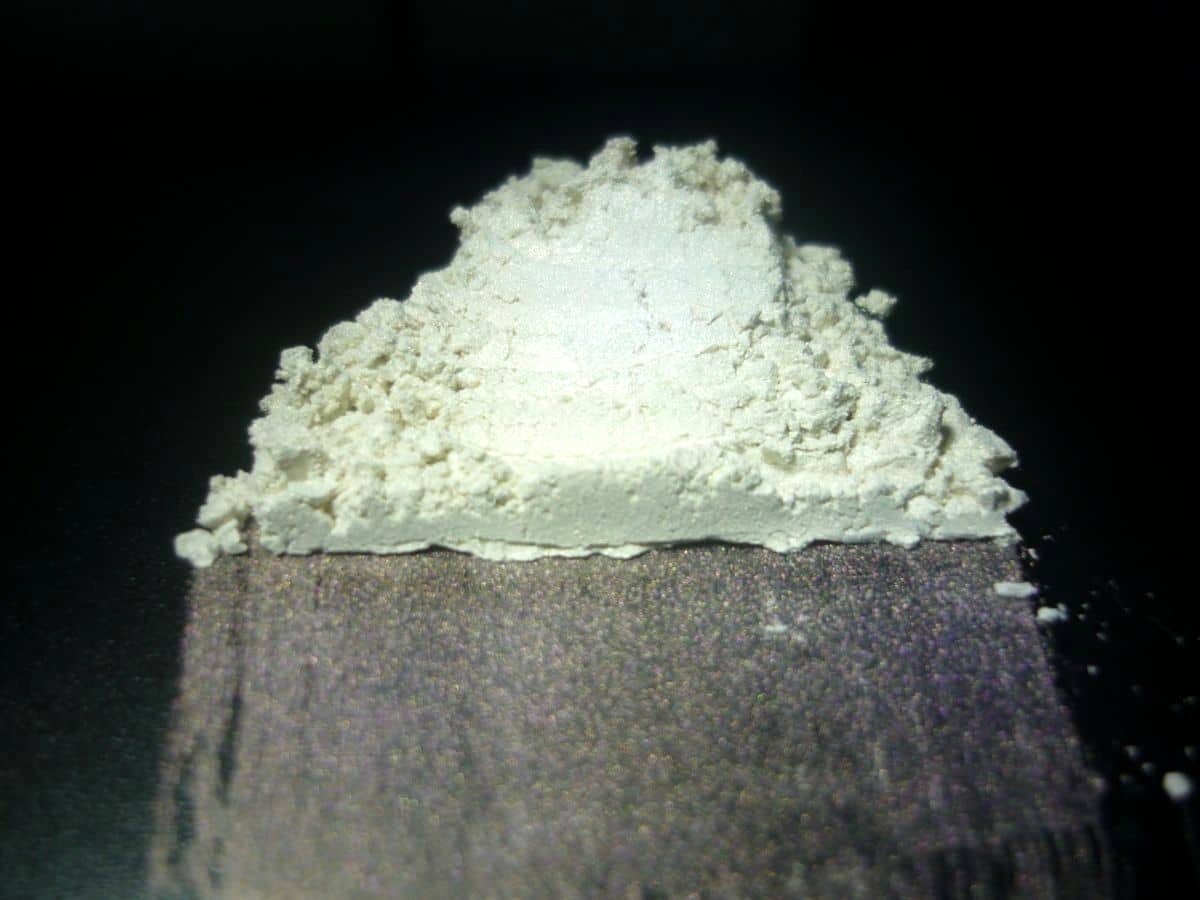
Fig. 4 — Pearl powder on the bench; the flake structure reads as a grainy sheen rather than a smooth dust.
What to ask for instead of a bleed guarantee
Ask a different question.
Do not ask a supplier for an unconditional guarantee that a colorant will not bleed. The outcome depends on what it touches, for how long, and at what temperature. Ask what the colorant's solubility tendency is in a plasticizer system, and which particle size grade you are being quoted.
Three things you can check:
- A particle size grade with a number on the TDS, not a range quoted over the phone.
- Whether the substrate is inorganic.
- What storage and separation the supplier recommends for finished parts.
| Colorant class |
Dissolved fraction in plasticizer |
Size and embedding check |
What decides the result |
| Soluble dye |
Depends on solubility and loading; may dissolve entirely |
No solid-particle barrier for the dissolved fraction |
Dissolved fraction and concentration difference between the two parts |
| Organic pigment |
May be partial |
Undissolved particles remain fixed while fully embedded |
How much dissolved, and whether the plasticizer raises that fraction |
| Inorganic pigment |
Almost none |
Particle size and embedding |
Whether the particle is fully embedded |
| Effect flake (mica + TiO₂) |
Almost none |
5–500 μm; retained while fully embedded |
Embedding, and how the parts are stored |
If a colorant still transfers after all that, the physics has not changed. Without changing the formulation, what is left to change is separation and temperature: a barrier between parts, and a cooler shelf. For the separate question of appearance and loading, see why pearl pigment clouds plastisol and how much to add.
Sourcing and Ordering
Pearl grades are available in μm bands: 5–20, 5–25, 10–40, 10–50, 10–60, 10–70, 10–100, 20–100, 30–150, 40–200 and 50–500. The substrate is mica, synthetic mica or borosilicate glass with a TiO₂ coating. Manufacturing is ISO 9001:2015 certified; other certificates are provided on request. MOQ is confirmed per grade and destination port. Full grade list: Pearl Pigment Color Cards.
Frequently Asked Questions
Same powder, deep colors bleed badly and light colors are fine. Is it the powder?
Not necessarily. What you see depends on the concentration difference across the contact face and on the dissolved fraction. A deep color can have more in solution and a steeper gradient, so the mark shows. Going lighter can hide the mark without eliminating the transfer.
I store the two baits apart and nothing happens. Does that mean my colorant is fine?
Separation solves most of it, and it is the most effective fix available. But it demonstrates that preventing contact prevents this contact transfer — it does not show that the colorant itself stays put. Judge the colorant on particle size grade and whether the substrate is inorganic.
A customer says our bait stained theirs. Do we owe them?
That one is answered by your own storage and packaging conditions, not by this mechanism. Three things to check: whether the two baits were pressed together during storage, the storage temperature, and which colorant system each bait used.
Send Us the Two Baits That Stained
If a batch came back with a color mark, send us both baits — the one that stained and the one that took the stain — plus the colorant grade each was made with. Include the storage temperature and whether the baits were touching. Talk to our technical team.
References
- 徐杨, 熊英, 郭少云, "软质PVC制品中增塑剂迁移带来的问题及应对", 《化学进展》, 2015, 27(2/3), 286–296
DOI: 10.7536/PC140826
- Ledniowska, K.; Nosal-Kowalenko, H.; Janik, W.; Krasuska, A.; Stańczyk, D.; Sabura, E.; Bartoszewicz, M.; Rybak, A., "Effective, Environmentally Friendly PVC Plasticizers Based on Succinic Acid", Polymers, 2022, 14(7), 1295
DOI: 10.3390/polym14071295
- Störmer, A.; Bott, J.; Kemmer, D.; Franz, R., "Critical review of the migration potential of nanoparticles in food contact plastics", Trends in Food Science & Technology, 2017, 63, 39–50
DOI: 10.1016/j.tifs.2017.01.011
- Sasayama, T.; Okamoto, H.; Sato, N.; Kawada, J., "Numerical simulation of plate-like particle orientation in injection molding", Powder Technology, 2022
DOI: 10.1016/j.powtec.2022.117481

 Français
 English
 Deutsch
 Русский
 Español
 Português